
The Hidden Cost of Entertaining the Wrong Franchise Leads – and How VR Solves It
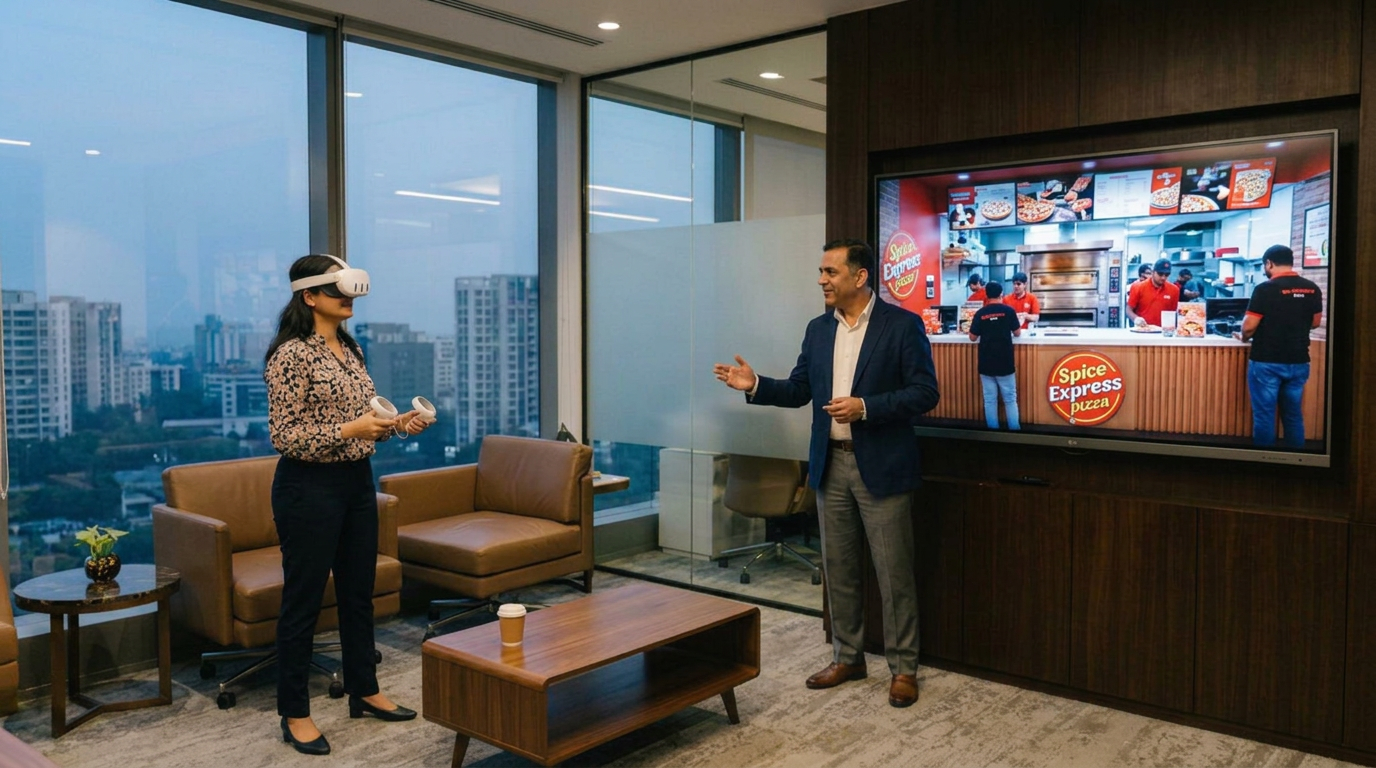
In franchising, volume is easy. Quality is rare.
Most brands generate plenty of inquiries—but spend disproportionate time on prospects who are curious, not committed. The real challenge isn’t getting more leads. It’s identifying the ones worth investing in.
Virtual Reality (VR), when used in-person by the franchisor, becomes a powerful qualification tool—not just a sales enhancer.
And importantly, this approach removes a common friction: prospects don’t need to own VR headsets. You control the experience. You control the environment. And you control who gets access.
Here’s how to use that to your advantage.
1. Turn Your Office into an “Investor Experience Center”
Instead of relying on decks and discussions, invite prospects to a curated, in-person VR session.
Using devices like Meta Quest 3 / 3S, you can host immersive walkthroughs of your franchise model right from your office or demo space.
What changes here is intent.
Anyone willing to:
- Schedule time
- Travel to your location (or meet at an event)
- Engage in a guided VR experience
…is already more serious than someone casually browsing a PDF.
You’re not just presenting the business—you’re testing commitment before the pitch even begins.
2. Use Guided VR, Not Self-Exploration
When prospects use VR on their own, the experience can be passive.
But when you guide them through it in person, it becomes a structured evaluation.
You can walk them through:
- Why the layout is designed a certain way
- Where operational efficiencies come from
- What differentiates top-performing outlets
Pause. Ask questions. Observe reactions.
This turns VR into a two-way filter:
- You assess how they think
- They assess how deeply they understand the business
The casual ones will nod and move on.
The serious ones will ask sharper, operationally grounded questions.
3. Simulate Real Operational Pressure—While You Watch
One of the biggest advantages of in-person VR is observation.
As investors go through scenarios like:
- Handling a peak-hour rush
- Resolving a customer complaint
- Managing staff coordination
…you can literally watch how they respond.
Do they:
- Engage actively?
- Hesitate under pressure?
- Ask insightful follow-up questions?
This is far more revealing than any conversation.
It helps you identify not just who is interested, but who is capable.
And for the investor, it sets clear expectations—this isn’t a passive income opportunity. It’s an operational business.
4. Replace Early Site Visits with VR Demonstrations
Many franchisors rush into physical site visits too early—often for unqualified prospects.
Instead, position your VR session as a mandatory precursor.
Before visiting a real outlet, investors must:
- Experience the virtual version
- Understand the flow and format
- Engage in a guided walkthrough
By the time they reach an actual site:
- They already “get” the model
- Their questions are sharper
- Their intent is clearer
This drastically reduces wasted visits and ensures that on-ground meetings are reserved for high-potential investors.
5. Make VR Access a Privilege, Not a Giveaway
Here’s where strategy matters most.
Don’t offer VR demos to everyone.
Instead, position it as:
“We invite shortlisted investors for an in-person immersive evaluation of the business.”
Now VR becomes:
- A signal of seriousness
- A milestone in your funnel
- A psychological commitment point
People value what feels selective.
And when access to the VR experience is earned, not given, it naturally filters out:
- Low-effort inquiries
- Casual explorers
- Price-sensitive dabblers
What remains are individuals willing to invest time before they invest money.
The Real Shift
Using VR in person isn’t just about better storytelling.
It’s about changing the dynamics of your franchise sales process:
- From open-access to curated engagement
- From information sharing to capability assessment
- From high-volume pipelines to high-quality conversations
And crucially, it solves the hardware barrier.
You don’t wait for investors to adopt VR.
You bring VR to them—on your terms.
Final Thought
Serious franchise investors don’t just look for opportunities.
They look for signals—of professionalism, structure, and long-term thinking.
An in-person VR experience sends exactly that signal.
It tells them:
“This is a business worth evaluating properly.”
And at the same time, it quietly tells everyone else:
“This may not be for you.”
Share This Story, Choose Your Platform!
LISTEN NOW

CAPTIVATING READS