
Why New Hires Leave Within 90 Days – and How VR Onboarding Can Reduce It
The first 90 days of a new employee’s journey are deceptively critical. While organizations often treat this period as a formality—focused on documentation, introductions, and basic training—it is actually when employees make a fundamental decision: Do I see myself here, or not?
A surprising number of employees choose the latter.
Early attrition is one of the most expensive and least discussed business leaks. Hiring costs are sunk, teams are disrupted, and managers are forced back into recruitment mode—all before the employee has contributed meaningful value. Understanding why this happens is the first step toward fixing it.
Why Employees Exit So Early
1. The “Reality Shock” Problem
Many new hires walk in with a mental picture of their role shaped by interviews, job descriptions, and employer branding. Within days, that picture starts to crack.
The work may feel different. The pace may be unexpected. The culture may not align with what they imagined. This gap between expectation and reality creates immediate friction—and for some, it’s enough to trigger an early exit.
2. Unclear Definition of Success
Clarity is often assumed, rarely delivered.
New employees frequently struggle to understand:
- What exactly is expected of them
- What “good performance” looks like
- How their role connects to larger business goals
Without this clarity, even capable employees feel lost. And when people feel lost, they disengage.
3. Lack of Belonging
Joining a company is not just a professional transition—it’s a social one.
When onboarding fails to foster genuine human connection, employees remain outsiders. This is particularly visible in hybrid and remote environments, where informal interactions are limited. Without a sense of belonging, commitment remains shallow.
4. Information Overload, Low Retention
Traditional onboarding often tries to do too much, too fast.
Slides, documents, policies, systems—all introduced within days. Employees may complete onboarding checklists, but very little of it sticks. The experience becomes transactional rather than transformational.
5. Passive Learning, Minimal Engagement
Most onboarding programs rely heavily on one-way communication—presentations, videos, or e-learning modules.
The problem? People don’t internalize what they passively consume. Without active involvement, learning remains superficial, and confidence takes longer to build.
The Core Issue: Experience vs. Information
At its heart, onboarding is not an information problem—it’s an experience problem.
Organizations focus on what to tell new hires.
Employees care about how it feels to be there.
This mismatch is where early attrition begins.
How VR Onboarding Changes the Equation
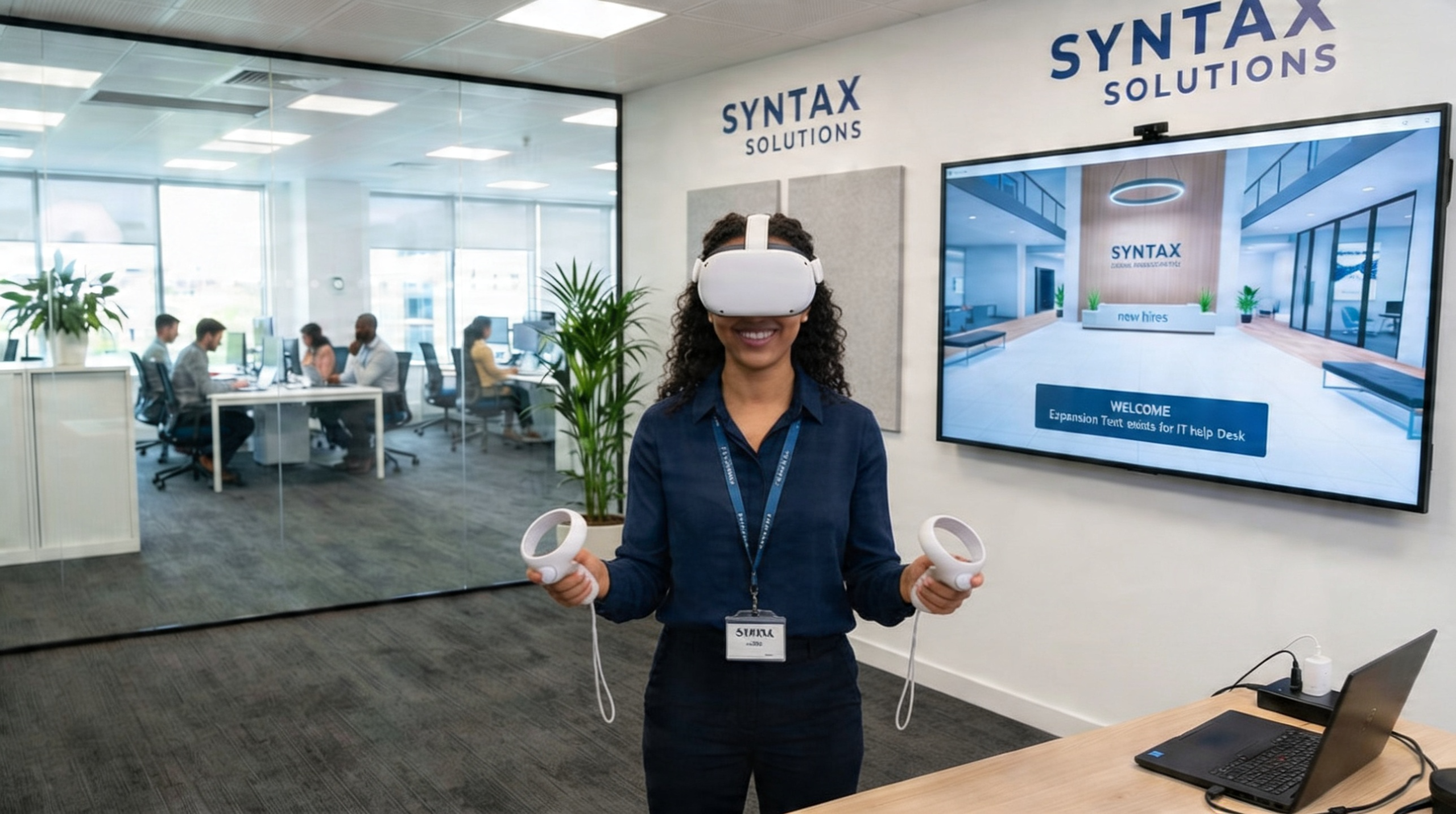
Virtual Reality (VR) introduces a fundamentally different approach. Instead of explaining the workplace, it lets employees step into it—before or during their early days.
1. Aligning Expectations Early
VR can simulate real work environments and scenarios, giving new hires a preview of what the job actually involves.
This reduces surprises and helps employees make informed decisions about their fit—before dissatisfaction sets in.
2. Making Roles Tangible
Abstract explanations are replaced with hands-on experiences.
Employees can:
- Interact with realistic work scenarios
- Practice tasks in a safe environment
- Understand workflows through doing, not just hearing
This accelerates clarity and builds confidence much faster.
3. Building Emotional Connection
VR has a unique ability to create presence.
Whether it’s a virtual walkthrough of the workplace, a message from leadership, or simulated team interactions, the experience feels personal. This helps employees connect with the organization on a deeper level from day one.
4. Turning Learning into Experience
Instead of passively consuming information, employees actively participate.
They make decisions. They explore. They engage.
This shift from passive to immersive learning significantly improves retention and recall—two factors that are critical in the early days of a job.
5. Delivering Consistency at Scale
In growing organizations, onboarding quality often varies by location, manager, or format.
VR standardizes the experience. Every employee, regardless of geography, receives the same high-quality introduction to the organization—ensuring alignment from the start.
The Bigger Impact
When onboarding becomes immersive and experience-driven, it does more than just inform—it shapes perception.
Employees feel:
- More confident in their role
- More connected to the organization
- More certain about their decision to stay
And that directly influences retention.
Final Thought
Employees don’t leave within 90 days because they lack capability.
They leave because the experience fails to meet expectations—emotionally, socially, or professionally.
VR onboarding addresses this gap by transforming onboarding from a checklist into a lived experience.
In a world where first impressions form quickly and decisions happen faster, that shift can be the difference between early exits and long-term commitment.
Share This Story, Choose Your Platform!
LISTEN NOW

CAPTIVATING READS