
Beyond Discovery Days: How VR Helps Franchise Buyers Evaluate Before Investing
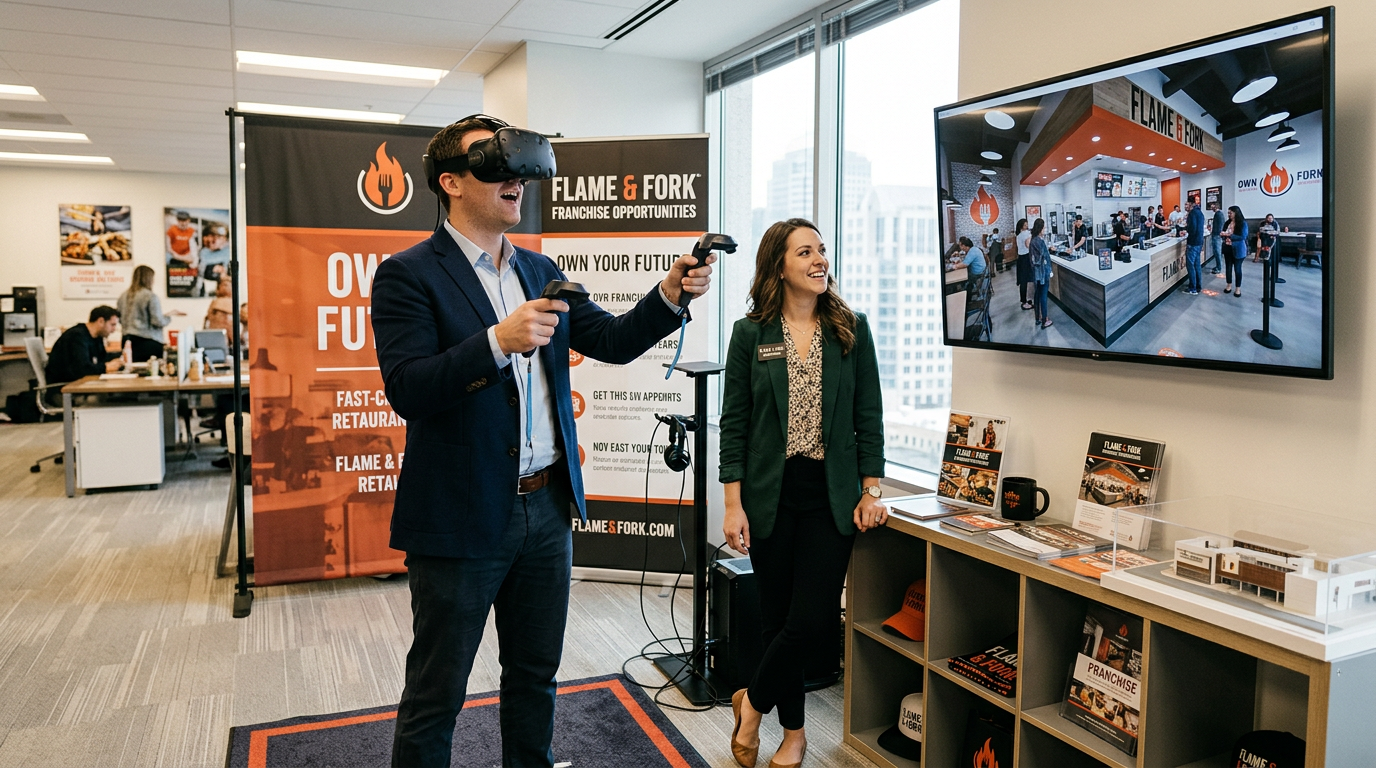
Buying a franchise is often positioned as a “proven path” to entrepreneurship. But for most prospective franchisees, there’s still a significant gap between what is presented and what is actually experienced.
Brochures highlight success stories. Discovery days showcase the brand. Financial models outline potential returns. Yet none of these fully answer a critical question:
“What will it actually feel like to run this business every day?”
This is where Virtual Reality (VR) is redefining how franchise decisions are made.
Instead of relying on interpretation, VR allows potential buyers to step into the business, interact with it, and evaluate it in a deeply experiential way—before committing capital.
From Information to Immersion
Traditional franchise sales are built around information delivery—presentations, PDFs, videos, and in-person visits. While useful, these formats are inherently passive. They require the buyer to imagine the business.
VR eliminates that mental gap.
By creating immersive, 3D environments, VR enables prospective franchisees to:
- Walk through a fully simulated outlet
- Observe how customers interact with the space
- Understand layout efficiency and operational flow
- Experience different times of day (peak vs. slow hours)
This shift—from passive learning to active exploration—dramatically improves clarity. Buyers are no longer guessing; they are experiencing.
Reimagining the Discovery Process
Franchise discovery days are traditionally resource-heavy. They require travel, scheduling, and coordination—and often limit exposure to just one or two locations.
VR transforms this into a scalable, on-demand experience.
With a VR-enabled discovery process, a potential franchisee can:
- Explore multiple locations without traveling
- Interact with simulated environments at their own pace
- Understand both front-end and back-end operations
For franchisors, this means being able to present their business consistently, regardless of geography. For buyers, it removes logistical friction and speeds up evaluation.
Seeing the Business as It Truly Is
Photos and videos can showcase aesthetics—but they rarely communicate spatial understanding.
VR changes that by offering:
- True-to-scale environments
- 360-degree visibility
- Freedom to navigate independently
This is particularly valuable in retail and service-based franchises, where layout and customer movement directly impact performance.
A prospective buyer can evaluate:
- How intuitive the store design is
- How customers move through the space
- Whether the setup aligns with operational efficiency
This level of spatial awareness is difficult to achieve through any other medium.
Understanding Operations Before Ownership
One of the biggest risks in franchise investment is underestimating the operational reality.
VR allows buyers to experience a simulated “day in the life” of the business.
This can include:
- Opening and closing routines
- Customer service interactions
- Staff coordination and task flow
- Handling peak-hour pressure
Instead of learning operations after investing, buyers gain early exposure to what running the business actually entails.
This leads to better self-assessment:
- Is this business aligned with my skills?
- Am I comfortable with the pace and nature of operations?
- Do I enjoy this environment?
These are critical questions that often go unanswered in traditional evaluations.
Experiencing the Business from a Customer’s Perspective
A strong franchise is built not just on operations, but on the experience it delivers to customers.
VR allows potential franchisees to step into that perspective.
They can:
- Enter the store as a customer
- Interact with products or services
- Experience the ambiance and brand personality
- Understand the emotional appeal of the offering
This helps buyers evaluate something that spreadsheets cannot capture—the strength of the customer experience.
It also builds conviction. When buyers personally experience the value of the offering, they are more likely to believe in the business.
Comparing Opportunities with Greater Ease
Evaluating multiple franchise locations or formats traditionally requires significant time and expense.
VR simplifies this process.
A buyer can explore:
- Different store formats (mall vs. standalone, large vs. compact)
- Multiple geographic locations
- Variations in customer flow and setup
All within a single session.
This ability to compare quickly leads to sharper decision-making and a better understanding of where and how the business performs best.
Bridging the Gap Between Numbers and Reality
Financial projections are a core part of any franchise pitch—but they are often abstract.
VR can bring these numbers to life.
For example:
- Footfall projections can be visualized as actual customer movement
- Peak-hour revenue can be experienced as operational intensity
- Bottlenecks can be seen, not just described
This creates a powerful connection between data and reality.
Instead of interpreting spreadsheets, buyers can understand what those numbers mean in practice.
Reducing Risk Through Clarity
Every franchise investment carries risk—financial, operational, and personal.
VR reduces this risk by improving pre-investment clarity.
When buyers fully understand:
- The environment
- The operations
- The customer experience
They are less likely to encounter surprises after onboarding.
This leads to:
- Better-aligned franchisees
- Higher confidence at the point of investment
- Lower drop-off or dissatisfaction post-launch
In essence, VR acts as a filter—ensuring that only well-informed, well-aligned buyers move forward.
Creating Emotional Connection
Decision-making is not purely rational. Emotion plays a significant role—especially in entrepreneurial investments.
VR creates a sense of presence that traditional media cannot replicate.
Buyers don’t just analyze the business—they feel it.
They can imagine themselves:
- Running the store
- Managing customers
- Being part of the brand
This emotional engagement often accelerates decision-making and strengthens commitment.
The Future of Franchise Sales
As technology adoption grows, expectations from franchise buyers are evolving.
They want:
- Transparency
- Convenience
- Real understanding before commitment
VR delivers all three.
Forward-looking franchisors are already using immersive experiences to:
- Stand out in a competitive market
- Attract more serious, qualified investors
- Scale their sales process globally
Over time, VR is likely to become a standard part of franchise evaluation—not a novelty, but a necessity.
Conclusion
Virtual Reality can change how franchise buyers evaluate opportunities.
It replaces imagination with experience, uncertainty with clarity, and passive learning with active exploration.
By allowing buyers to step inside the business before investing, VR enables:
- Deeper understanding
- Better decision-making
- Stronger alignment between franchisor and franchisee
For anyone considering a franchise investment, the question is no longer just “Is this a good business?”
It becomes:
“Have I truly experienced it?”
And increasingly, VR is the tool that makes that possible.
Share This Story, Choose Your Platform!
LISTEN NOW

CAPTIVATING READS